

The castle gates are ajar.
But then again, they always are.
That’s thanks to one Gráinne Ní Mháille (perhaps better known as Grace O’Malley), Ireland’s notorious 16th-century pirate queen. As the legend goes, while sailing near Dublin, she docked at Howth to request dinner at the castle. This was a fairly standard expectation in a country still beholden to Brehon law, which valued hospitality as something of a sacred duty. But the Lord of Howth, whether absent, indifferent, or maybe both, instructed his gatekeepers to turn away the uninvited guests.
Insulted, the pirate queen did, naturally, what we’d all do in such a situation—she kidnapped the lord’s nephew and heir, holding him hostage until she could strike a deal with the Howth family.
The deal ensured that from that day forward, the gates of Howth Castle would remain open to all, and a spare seat would always be set at the table. The Howth family still live in the castle, and, supposedly, diligently uphold said promise, laying out a seat for any surprise guests.
Is any of this true? Who knows.
Maybe.
Maybe not.
But in the words of Mark Twain, "Don’t let the truth get in the way of a good story."
In Ireland, truth and myth don’t always necessarily live on opposite ends of the bar. More often than not, they’re usually jostling shoulders trying to sip from the same pint…
And this is the kind of story Dublin is full of.
Just not always where you’d expect.
Your chance to retire overseas now
Your chance to retire overseas now
Learn more about Ireland and other destinations by signing up to our daily IL Postcards e-letter and we'll immediately send you a free report: 20 Countries Compared, Contrasted, Ranked, and Rated.
You don’t have to be rich to enjoy a pampered retirement, you just need to know where to go.
With our 34th Annual Global Retirement Index, our experts hand you a detailed roadmap. Details and a Special Offer Here!

By submitting your email address, you will receive a free subscription to IL Postcards, The Untourist Daily and special offers from International Living and our affiliates. You can unsubscribe at any time, and we encourage you to read more about our Privacy Policy.
The Dublin City Spire—A Criticism
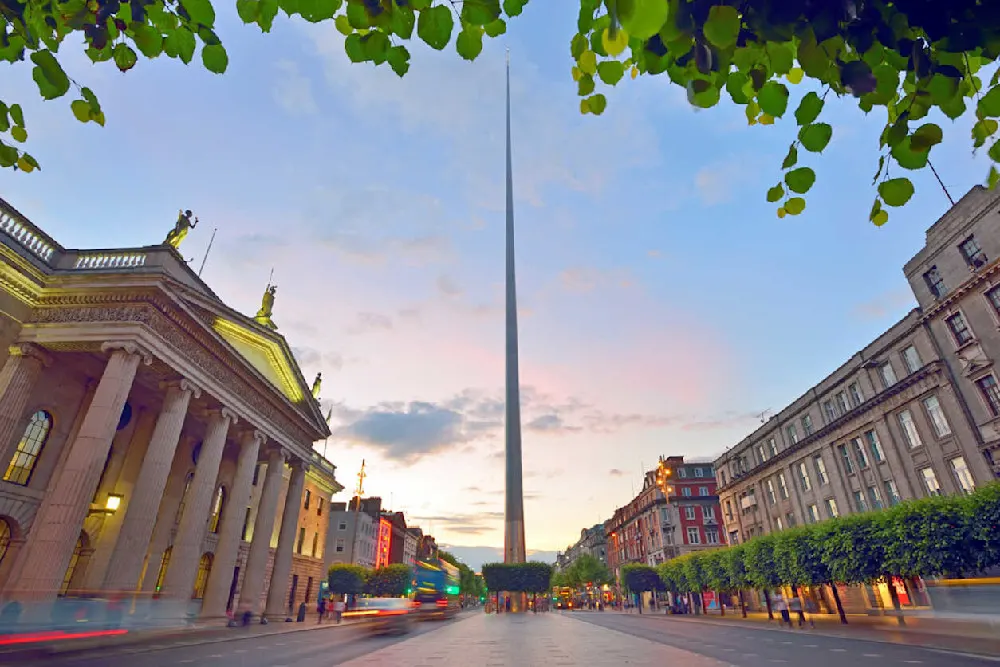
As a native of Dublin, and a self-professed history nerd, it brings me no joy to say this… Dublin is a city of immense historical scope, but its modern urban makeup does a grave disservice to this lineage.
Spanning across other European capitals, you can marvel at the crumbling heritage of the Roman Empire in Rome, gaze at Paris’s monumental Arc de Triomphe, and walk the perimeter of Berlin’s towering, authoritative Brandenburg Gate.
And yet, Dublin’s O’Connell Street, arguably the largest and busiest street in the entire country, is virtually bereft of any sort of major monument of historical significance.
So what do visitors generally do when they first hit O’Connell Street? They walk over and gawk at the Spire.
What is the Spire, I hear you ask? Is it a storied heirloom of a bygone Irish high-king? A lingering testament to the birth of a young Republic, forged in the Easter Rising of 1916?
No—it’s a giant, metal stick.
The Spire was first intended as a celebratory offering to the city, marking the coming of the year 2000. (In typical Irish fashion, construction was delayed until 2002, before reaching completion in 2003.)
The conversation around the Spire was divisive. There were those who did, and still do, point to the initial negative reception to the Eiffel Tower, now arguably France’s iconic cultural image.
On the other hand, the general reaction to the Spire seemed to be a resounding "meh." Detractors delighted in coming up with a barrage of disparaging monikers for the oft-maligned Spire. "The pin in the bin," "the spire in the mire," and even the somewhat crude "stiffy in the Liffey" (the river Liffey bisects Dublin City…).
That the Spire is likely the first thing so many visitors happen upon when they arrive in Dublin City is a cringeworthy offence. They don’t get the story of Grace O’Malley and Howth Castle, they don’t learn of what happened in the Battle of Clontarf, they don’t walk the Fairy Paths along the sweeping Howth cliffs.
And this is such a shame. Irish, and by extension, Dublin’s history and mythology twists, dances, and dives, a bitter tapestry inscribed in blood, tears, and toil.
I am not telling you to skip Dublin city. There is still plenty to do and see. In fact, the very point of this article is to try to encapsulate the great allure of Irish history, and how exactly you can find it. Places within the city, like Christchurch Cathedral, the Guinness Storehouse, and Kilmainham Gaol have a wonderful, storied past. But if you come to Ireland expecting a visual marvel comparable to the monstrous form of Il Duomo in Milan… Well let’s just say you’re probably going to be disappointed.
Irish history is not grandiose and it doesn’t need to have extravagant monuments in its name. It’s distinct, it’s bittersweet, it’s often despondent, and it’s uniquely ours.
So be under no illusion—Dublin is a place with a historical narrative that can rival some of the most illustrious cities on the planet.
But Ireland’s history and legends don’t live in shopping districts or under mirrored office blocks.
They live along the edges—where land meets sea, and memory meets place.
You’ll find them in the sweep of Bull Island, in the stones of Howth Castle, in the monks’ ruins on Dalkey Island. You’ll find them in pubs where poets drank and in cliff walks that feel like passages between worlds.
That’s the journey we’re about to take—chasing myths along the coast of Dublin. Starting just a few miles east of the city center, where a Viking army met its savage end.
Welcome to Clontarf.
Clontarf—From Viking Massacre to Charming Seaside Suburb
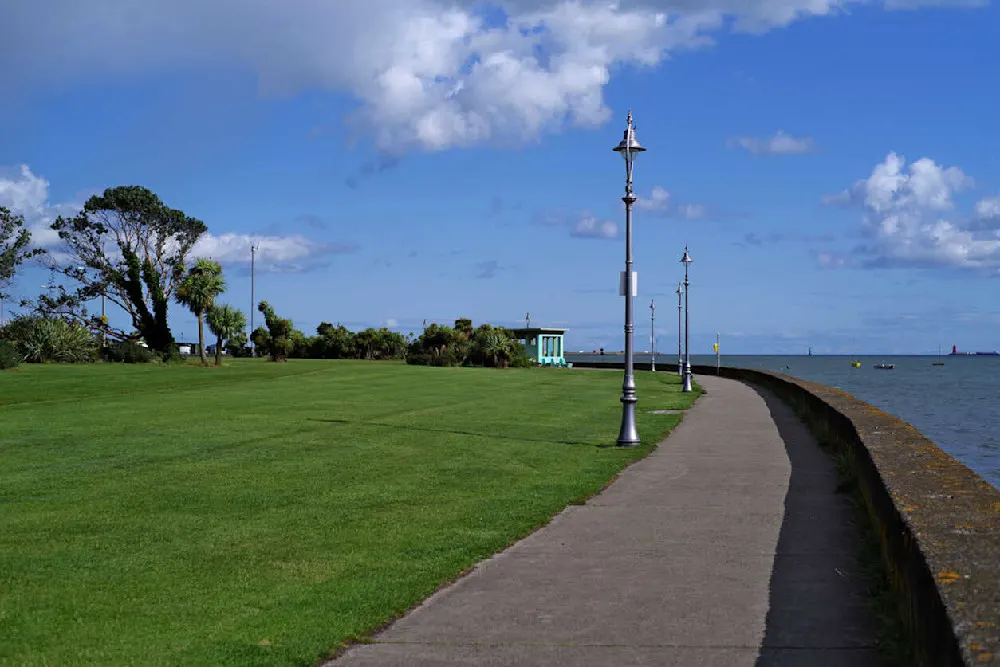
On your flight from the urban miasma that is inner Dublin City, the concrete eventually gives way as you pass through Fairview and broach Clontarf.
Clontarf is not a flashy place, in spite of what the property costs might suggest. There’s no dramatic sheer cliff face, and no imposing castle dominating the vista.
Clontarf served as the backdrop for Ireland’s "high king" Brian Boru’s crushing victory against a horde of Viking invaders in the year 1014. Boru, at this point in his 70’s, was murdered in his tent at the culmination of the battle, by a lone Viking who snuck through the lines.
Thankfully, modern Clontarf offers a more peaceful environment. For what it lacks in immediate visual impressiveness, it makes up for with a distinguished coastal character.
Bull Island is a UNESCO-recognized biosphere, and a must for those with an affinity for the natural world. Trek across the wooden bridge, and if you’re feeling brave (and the tide is in!), why not take a plunge—on any kind of warm day, you’re sure to see a bunch of locals enjoying a sea swim, so feel free to join in.
Or take a wander through St. Anne’s park, where if you search hard enough, you’ll come across a beautiful, Asian-style Suzhou garden, modeled after what you may find in eastern China—it was actually designed and donated by the Chinese government in 2012, as part of Bloom festival.
It’s a real treat, a quaint little escape even in the relative peace of the park, and it’s even better if you happen to just stumble upon it by yourself. It’s in the north-west corner, and that’s all the hint you’re going to get.
Your chance to retire overseas now
Your chance to retire overseas now
Learn more about Ireland and other destinations by signing up to our daily IL Postcards e-letter and we'll immediately send you a free report: 20 Countries Compared, Contrasted, Ranked, and Rated.
You don’t have to be rich to enjoy a pampered retirement, you just need to know where to go.
With our 34th Annual Global Retirement Index, our experts hand you a detailed roadmap. Details and a Special Offer Here!
By submitting your email address, you will receive a free subscription to IL Postcards, The Untourist Daily and special offers from International Living and our affiliates. You can unsubscribe at any time, and we encourage you to read more about our Privacy Policy.
Howth—Pensinular Pirates, Yeats, and Seawalks
"At Howth… there is a fairies path, whereon a great colony of otherworld creatures travel nightly from the hill to the sea and home again."
This is a line from renowned Irish writer and poet William Butler Yeats’ essay "Irish Fairies," of which he was apparently a staunch believer. W.B. Yeats’s fascination with Irish mythology was likely facilitated by his time staying in a small cottage perched on Balscadden Bay, in Howth. And it’s easy to see why.
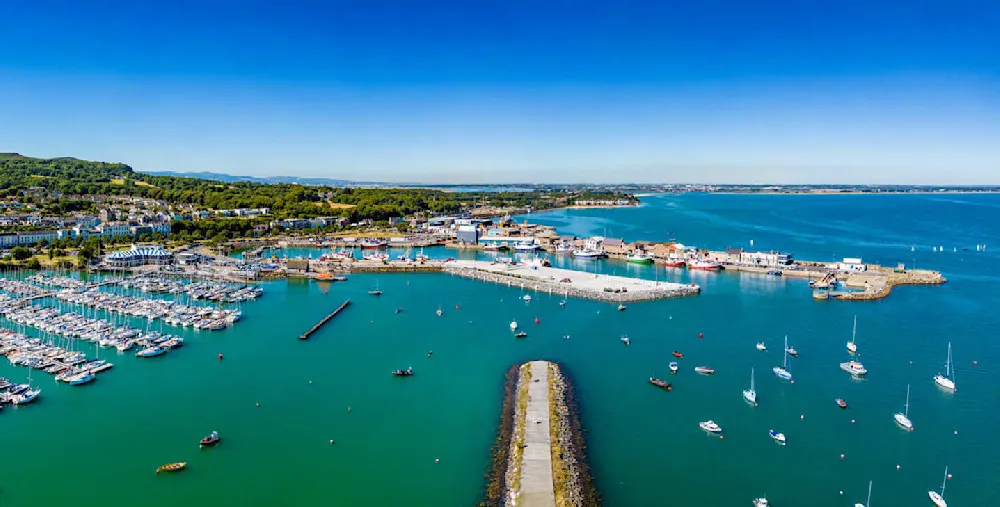
Howth is Dublin’s shoulder to the sea, at once tilted, weathered, and yet irresistibly charming. You don’t arrive in Howth so much as cross into it. The DART train curves around the headland, and suddenly the landscape shifts, the air sharper, the sea louder. You’ll find the harbor bustling with activity, as yachts and small fishing vessels alike moor side by side.
In particular, the Howth Cliff Walks feel mythic, like a liminal path between the world of the living and something just beyond it. Much of Yeats’ essays and early poems describe the meandering landscape as one in which the world we know and the idea of an ethereal spirit world hover perilously close together. And if you embrace the idea, walking the cliff path today, you can almost feel it: the ancient rhythm of footfall on earth, the sea pounding below like a distant drum. Along these trails, Irish mythology feels present—not in the form of monuments, but in the air itself. One could almost stumble straight into Tír na nÓg without even noticing the shift…
On the grounds of the aforementioned Howth Castle, forage and see if you can locate "Aideen’s Grave." A dolmen tomb of a warrior’s wife, who perished from sheer grief after her husband was killed in battle.
Follow the trail downward back towards the train station, where directly underneath, you can pop into the Bloody Stream for a quick pint… The pub’s name comes from a great battle in 1177, as part of the second Norman invasion of Ireland. The blood from the fighting mingled with the trickling stream that has so often caused flooding damage to the bar…
Dalkey—Saints, Scholars, and Submarines
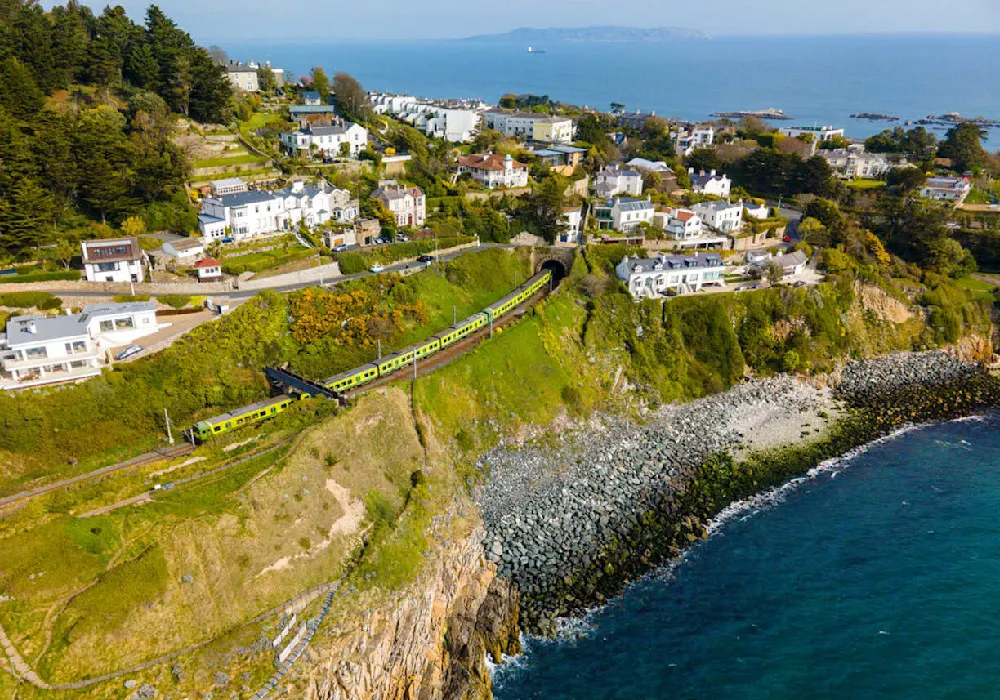
Dalkey Island boasts archaeological evidence of inhabitants dating back 6,000 years ago, and upon the arrival of Christianity to the Emerald Isle, it developed a reputation of a place of revered pilgrimage. Referred to mostly as "St. Begnet’s" Island, 15th-century sailors believed water collected from the island’s well protected them from scurvy.
Reportedly, modern water testing revealed a high dose of vitamin C in said water, but again, here’s myth and truth jostling at the bar once more… Today you can see the remains of a Martello tower, a relic of the pervasive fear of a Napoleonic invasion, along with monastic ruins.
Dalkey town would serve as one of Dublin’s preeminent medieval ports, but today, tends to trade in rather different cargo: a prestigious literary heritage, and affluent seaside hangout to the rich and famous (most notable, Bono).
Dalkey’s reputation as one of Ireland’s most notable literary towns cannot be overstated. Simply strolling the streets you’ll pass the previous homes of writers and poets like George Bernard Shaw, Maeve Binchy, and playwright Hugh Leonard. Even Flann O’Brien’s absurdist novel, The Dalkey Archive, sees characters such as James Joyce and St. Augustine mired deep in conversation aboard a submarine… And yet that seems supremely in character for a place like Dalkey.
And on the topic of Joyce, he spent a time in Sandycove, just south of Dalkey, where the famous Martello Tower serves as the opening setting of Ulysses. Today it houses the James Joyce Tower and Museum, perched above the rocks at the Forty Foot.
In a more historical lens, and in contrast to its more quaint counterpart in Howth, Dalkey Castle offers one of the more delightfully unhinged historical tours in Dublin. Actors decked out in full regalia will teach you how to kill a man with a crossbow, diagnose the bubonic plague, or prepare for a Viking raid.
When visiting Dublin, the city doesn’t necessarily reveal itself all at once. You won’t find its soul in the shadow of the Spire or on a postcard of the Liffey.
In Clontarf’s tide-washed quiet, Howth’s wind-whipped cliffs, Dalkey’s story-soaked streets… The myths aren’t dead here. They’re just quieter now. Folded into the hills, hidden in tidepools, whispered across pint glasses and skittering across footpaths. And if you look hard enough, you might just begin to hear them.
Your chance to retire overseas now
Your chance to retire overseas now
Learn more about Ireland and other destinations by signing up to our daily IL Postcards e-letter and we'll immediately send you a free report: 20 Countries Compared, Contrasted, Ranked, and Rated.
You don’t have to be rich to enjoy a pampered retirement, you just need to know where to go.
With our 34th Annual Global Retirement Index, our experts hand you a detailed roadmap. Details and a Special Offer Here!
By submitting your email address, you will receive a free subscription to IL Postcards, The Untourist Daily and special offers from International Living and our affiliates. You can unsubscribe at any time, and we encourage you to read more about our Privacy Policy.