

The first time I ever spent a night in the hospital was in Bangkok, Thailand. A CT scan during my annual check-up revealed a condition requiring the opinion of a specialist. I was panic-stricken.
As I sat in the waiting area for the Urology Clinic at Bumrungrad International Hospital, my head was swimming with questions. Should I fly home to the US? Will they take my insurance here? This hospital sure is nice, but do these people know what they’re doing?
A nurse led me to a consultation room where I sat at a desk and watched a diminutive old Thai doctor with bushy white eyebrows perusing my CT scans on a giant flat screen. After a few minutes, he turned to me and said, “How do you feel?” I can’t explain why, but all my anxiety melted away. Somehow, I knew I was in good hands.
Dr. Apichat assured me that my condition wasn’t life-threatening and set me up with an appointment for laparoscopic surgery the following week. When I got back to my apartment, I Googled him. That old Yoda-looking doctor went to medical school in Japan, Germany, and the US. He’s a professor and trains surgeons at Thailand’s most prestigious medical school. Good hands, indeed!
The World’s Best Retirement Havens for 2026
The World’s Best Retirement Havens for 2026
24 Countries Compared, Contrasted, Ranked, and Rated. You don’t have to be rich to enjoy a pampered retirement, you just need to know where to go. With our 35th Annual Global Retirement Index, our experts hand you a detailed roadmap. Details—and a Special Offer—Here

By submitting your email address, you will receive a free subscription to IL Postcards, The Untourist Daily and special offers from International Living and our affiliates. You can unsubscribe at any time, and we encourage you to read more about our Privacy Policy.
Medical Tourism Mecca
Something else that surprised me was the hospital facility. Bumrungrad International Hospital is renowned worldwide as a premier destination for medical tourism. Upon entering the main building, the atmosphere was akin to that of a busy five-star hotel, not a place for the sick. Cozy coffee shops, a whole floor of restaurants, and a multitude of multilingual helpers in sparkling white uniforms guide visitors through the largest “medical mall” in Bangkok.
Two years ago, I was shopping around for a place to get a hip replacement when I discovered that most of the hospitals I’d been recommended had the same vibe. The Samitivej Hospital in Bangkok’s Silom neighborhood is so welcoming that I returned twice just to have the homemade muffins in their coffee shop.
I finally settled on their branch in Sriracha for my second hip replacement. Another expat recommended it because it isn’t a “medical tourism” area but rather serves the huge expat community that works in the massive industrial estates near the port of Laem Chabang. The price was considerably less than in Bangkok, and it was only 40 minutes from my house.
Thailand vs. U.S.: My Two Hip Surgeries Compared
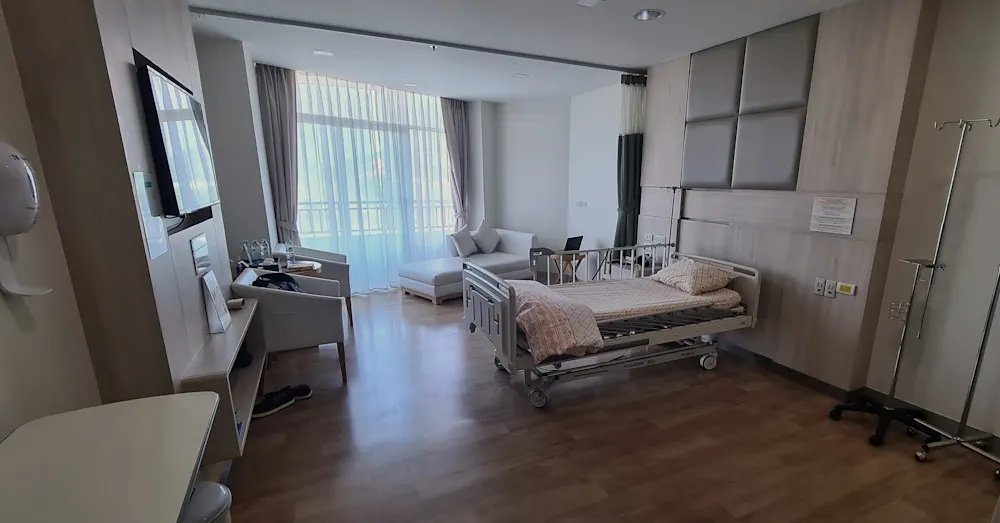
I’d had a hip replacement done about five years earlier at the Veterans Administration (VA) flagship medical center near Orlando, FL. The journalist in me was keen to contrast and compare hip #1 versus hip #2.
The first difference that jumped out was the projected length of stay. At the VA, I was in and out in a day and a half. In Thailand, I was scheduled for a three-night stay, which I didn’t expect, but at least I was given a room with a sea view.
In the US, I was given a thorough physical exam, complete with an EKG and blood work, about a week before the surgery. In Thailand, I came for the same type of exam the day before the surgery, and the hospital was kind enough to let me check into my room a night early at no extra charge.
On the morning of the procedure, a Thai anesthesiologist came to my room to consult with me about the type of anesthetic I preferred and explained the difference relative to my recovery. I was not offered such a choice in the US.
In Thailand, the surgeon came to my room before the operation to go over the procedure and calm my nerves. In the US, they wheeled me into the operating theater at the crack of dawn, and I vaguely remember hearing the song “Scar Tissue” by the Red Hot Chili Peppers playing. My American surgeon had a dark sense of humor, which I must admit I appreciated.
I spent most of my recovery time in the US, eating pizza and watching football from my brother’s sofa. Physical therapists visited the house a few times to ensure I was completing all the exercises they prescribed. In Thailand, I spent three days being hovered over by an army of nurses and physician assistants. There was no formal physical therapy except for walking up and down the hall.
On the day I checked out of the hospital in Thailand, a pharmacist came to my room with a bag full of drugs, and all my prescriptions had already been prepared. She gave me instructions and choices of which kind of painkillers I preferred. In the US, I waited at the hospital pharmacy for an hour after being released and was sent home with a big jar of strong opiates and the laxatives you need to go with them. I was relieved to be less medicated when I left the hospital in Thailand.
Thailand’s Lower Costs—and Better Care

Now, I’ve got a pair of state-of-the-art hips made of some space-age polymer that should last me a few decades. It is difficult to determine the actual cost differential because I didn’t have to pay for the operation at the VA. My second operation was performed in Thailand because it was during COVID-19, and the world was locked down.
The average cost for a total hip replacement in the US is $35,000 to $40,000.In Thailand, I paid 405,000 THB (about $12,000). This is pretty typical of what I’ve seen for most major surgeries performed here. Figure on paying one-third of the going rate in the US.
One big difference I noticed between hospitals in Thailand and those in the US was staffing. There were 15 rooms in my ward, which was staffed by 4 to 6 RNs and a large team of PAs and helpers at all times.
There were so many of them checking on me that by the third day, I was starting to feel a little annoyed. When I got grouchy and complained, the Head Nurse gave me a sly smile and revealed that she had been sending the younger staff in to practice speaking English with me. “We get mostly Japanese and Koreans,” she said. “But we love getting Americans so we can learn to speak Tom Cruise English.”
Yes, even in a swanky hospital, it’s still Thailand.
Your chance to retire overseas now
Your chance to retire overseas now
Learn more about Thailand and other destinations by signing up to our daily IL Postcards e-letter and we'll immediately send you a free report: 20 Countries Compared, Contrasted, Ranked, and Rated.
You don’t have to be rich to enjoy a pampered retirement, you just need to know where to go.
With our 34th Annual Global Retirement Index, our experts hand you a detailed roadmap. Details and a Special Offer Here!

By submitting your email address, you will receive a free subscription to IL Postcards, The Untourist Daily and special offers from International Living and our affiliates. You can unsubscribe at any time, and we encourage you to read more about our Privacy Policy.
Finding the Right Health Insurance Abroad
Shopping for health insurance overseas can be daunting. Most people choose a package they can afford from a company they’ve heard of and hope for the best. Nobody knows what their coverage is until they need it.
Google “health insurance for expats,” and all the major insurance players will appear on your screen. BUPA, AIG, Aetna, AXA, Cigna, Alliance, and Pacific Cross are the primary carriers in this region. Expats can navigate their English-language websites, obtain quotes for various plans, and arrange coverage online without ever needing to interact with another person.
During my early years in Thailand, I held a policy with Cigna that I enrolled in online. When I needed minor surgeries, I provided my policy number to the hospital's administrative staff, and everything was taken care of. I never even saw a bill.
Big vs. Local Insurance: What to Know
Everybody uses the same actuarial tables, so when it comes to these huge international insurance providers, the pricing is quite similar. What you are really comparing is the quality of customer service. With Cigna, I had to deal with an office in London. Another company I was with for a year had a local sales team, but all claims and complaints were directed to a call center in the Philippines. They were courteous but not very helpful.
Those big carriers also limit your policy options. If an American examines the levels of coverage offered in their Gold, Silver, and Platinum packages, it appears quite normal. However, the lowest level of coverage offered would be drastic overkill in Thailand. Nobody needs five million dollars in medical coverage here. Many make the mistake of paying for insurance they couldn’t possibly use.
The Key to Navigating Insurance in Thailand
The likelihood of engaging with a customer service representative who can help negotiate issues such as payment plans, pre-existing conditions, and medical evacuations is quite slim with the big carriers. It helps to find the right middleman.
In Thailand, the American Embassy has a list of trusted insurance agents on its website. The American Chamber of Commerce here also has a list of preferred vendors.
The top firm in my area is Global Insurance, run by a German expat who has been in the country for over 20 years and in the insurance business for nearly 4o years. He, his Thai wife, and their sons have been brokering all types of insurance here in Thailand since 2001.
When I visited their office, they asked me about my requirements, budget, and any special needs I might have. Within a day, I received three proposals, all of which included negotiated arrangements for pre-existing conditions, a monthly payment plan, and an option to freeze my coverage for a specified period if I were to leave the region.
I ended up with a plan that was a third cheaper than the one I had before, and if I have any issues with coverage or claims, I have Global’s team of seasoned agents to assist me.
When you find a health insurance provider that meets your needs at a price you can afford, stick with them. My experience has been that most of the problems expats have with health insurance here are related to skipping from one provider to the next.
Why Staying Healthy is Easier in Thailand
World-class healthcare in my adopted home of Thailand is much more affordable and accessible than in the US, but it doesn’t come knocking on your door. Annual check-up plans and screenings for potentially dangerous conditions, such as cancer and heart disease, are available from dozens of major hospitals and clinics throughout the country. It’s still up to the individual to take advantage of these plans and follow up regularly.
Maintaining good health in Thailand is made easier by having access to fresh, clean food choices and an inherently more active lifestyle. Additionally, quality care from highly trained medical professionals at state-of-the-art facilities is available, accessible, and affordable.
There’s simply no reason not to get healthy and stay that way.
Your chance to retire overseas now
Your chance to retire overseas now
Learn more about Thailand and other destinations by signing up to our daily IL Postcards e-letter and we'll immediately send you a free report: 20 Countries Compared, Contrasted, Ranked, and Rated.
You don’t have to be rich to enjoy a pampered retirement, you just need to know where to go.
With our 34th Annual Global Retirement Index, our experts hand you a detailed roadmap. Details and a Special Offer Here!
By submitting your email address, you will receive a free subscription to IL Postcards, The Untourist Daily and special offers from International Living and our affiliates. You can unsubscribe at any time, and we encourage you to read more about our Privacy Policy.