

When I embarked on my backpacking trip around Southeast Asia, I left with one of the world’s first travel laptops.
Sure, it was clunky. It had very little RAM, storage, or any of the other bells and whistles you’d look for in a laptop. This was 2008, after all.
I was a digital nomad before digital nomads were even a thing.
Leaving for a year of backpacking with only $5,000 in my bank account, I knew I’d have to supplement my savings with work. And I was fantasizing about lazing back on the beach with my laptop long before anyone was posting about it on Instagram.
But the reality proved very different.
Which is why, when I recently saw a front-page article in a major U.K. newspaper featuring someone who makes six figures working from the beach in Thailand—laptop open, drink in hand, bare feet in the sand—I scoffed.
Not because it’s impossible to build a remote income abroad. I’ve done it for 16 years. But because I’ve tried working from the beach. A lot of people have. And the practical reality does not match the dream.
Your chance to retire overseas now
Your chance to retire overseas now
Learn more about Thailand and other destinations by signing up to our daily IL Postcards e-letter and we'll immediately send you a free report: 20 Countries Compared, Contrasted, Ranked, and Rated.
You don’t have to be rich to enjoy a pampered retirement, you just need to know where to go.
With our 34th Annual Global Retirement Index, our experts hand you a detailed roadmap. Details and a Special Offer Here!

By submitting your email address, you will receive a free subscription to IL Postcards, The Untourist Daily and special offers from International Living and our affiliates. You can unsubscribe at any time, and we encourage you to read more about our Privacy Policy.
The Part They Leave Out of the Instagram Caption
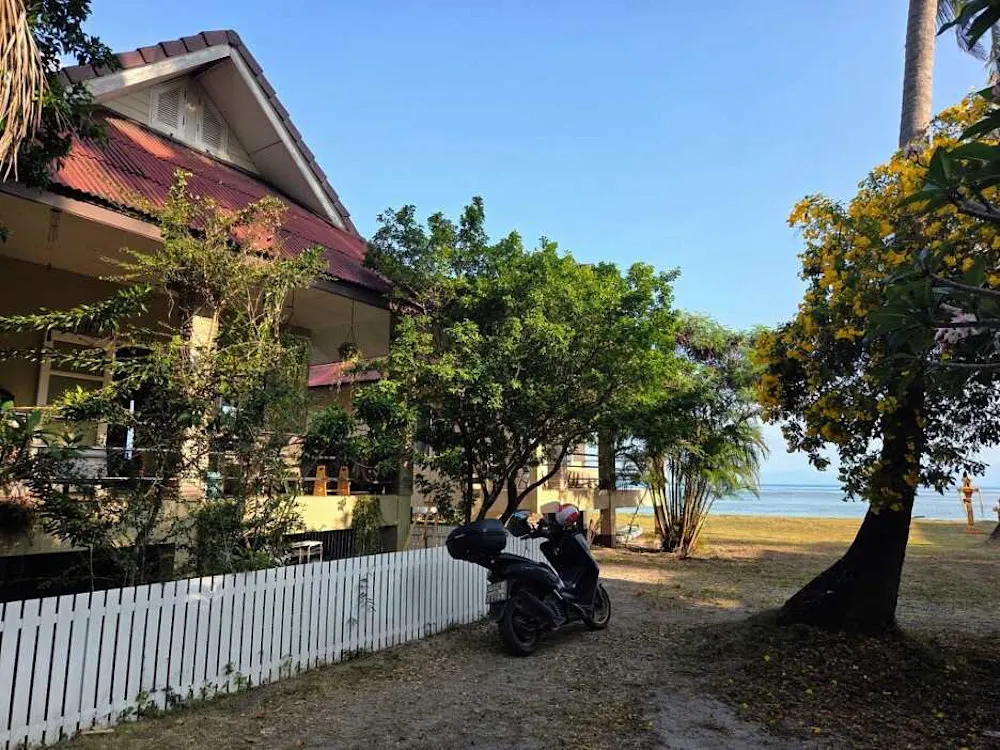
Myth #1: You can work from the beach.
Have you ever actually tried it? First, there’s power—beaches don’t tend to come with charging ports. Then there’s the heat. If you’re somewhere warm enough to have a beach worth working on, you’re somewhere hot enough to make a laptop on your lap feel like a punishment. Even in the shade, tropical sun on a screen is brutal. You crank the brightness up, which drains your battery faster, which brings you back to problem one. And then there’s the sand—a bane to keyboards worldwide. I still shudder at the crunching sound of sand under keys, having been scarred during that first backpacking trip. The beach is a beautiful place to take your lunch break. It is not an office.
Myth #2: The internet is reliable everywhere now.
It isn’t. Not even close. In 2025, at my mother’s place in Mexico, with the best internet in the area, I couldn’t upload a video my client needed. That’s not a developing-world anomaly—that’s the reality across enormous swaths of the warm-weather destinations people are flocking to. And it’s not just about speed. In most tropical destinations, the power and internet grids are simply less stable than what you’re used to back home. I once lost island-wide electricity because a chicken ran into a generator. My investor presentation went down with it. The chicken did not care about my pitch deck.
Myth #3: Remote work is an easy ticket in.
Remote jobs are fiercely competitive right now. The internet has leveled the playing field in ways that are genuinely exciting—and genuinely brutal if you’re building a remote income. Employers can hire talent from anywhere, which means you’re not competing with your city anymore. You’re competing with everyone. I’ve been building my remote career for 16 years, and it has never been harder to land and keep good clients than it is right now. The dream is real, but the income doesn’t arrive just because you bought the plane ticket.
Myth #4: Time zones are just a minor inconvenience.
They can be—or they can reshape your entire working life. Most of my calls have to happen after my son is in bed. Some as late as 11 or midnight. It’s why I haven’t done many Substack live sessions: my readers’ time zones require me to show up at a time when my brain has ceased to function. It’s held me back in ways I didn’t anticipate. Time zones aren’t just a scheduling challenge. They can become a ceiling.
Myth #5: Remote work is just office work, but better.
Offices exist for a reason. Being physically around your teammates creates an energy and atmosphere that you cannot replicate when everyone is working from their separate corners of the world. The unavoidable truth is that it takes more time and energy to work through something asynchronously over text than it does to roll your chair around and have a five-minute conversation. And scheduling that five-minute video call, while navigating different work schedules and time zones, is its own task entirely.
Good News: It’s Figureoutable
Here’s the thing nobody puts in the headline photo: the people who make remote work abroad actually work aren’t living the fantasy. They’re solving a puzzle.
The beach laptop life fails when you treat it as a lifestyle. It works when you treat it as a logistics challenge you’re committed to figuring out. After 16 years of working remotely from Thailand, I’ve learned that the setup matters as much as the destination. Get the setup right, and the dream is genuinely livable. Get it wrong, and paradise becomes the world’s most scenic source of stress.
So here’s what getting it right actually looks like.
The World’s Best Retirement Havens for 2026
The World’s Best Retirement Havens for 2026
24 Countries Compared, Contrasted, Ranked, and Rated. You don’t have to be rich to enjoy a pampered retirement, you just need to know where to go. With our 35th Annual Global Retirement Index, our experts hand you a detailed roadmap. Details—and a Special Offer—Here

By submitting your email address, you will receive a free subscription to IL Postcards, The Untourist Daily and special offers from International Living and our affiliates. You can unsubscribe at any time, and we encourage you to read more about our Privacy Policy.
The Day I Worked From a Building Site in a Monsoon
When we first moved to the island, we rented a house that was a great deal, but had no mobile phone signal and no Wi-Fi lines running to it either. We paid through the nose to have one installed, and the line was so long and fragile that one drop of rain knocked it out. We couldn’t call the Wi-Fi company from the house because there was no signal, so we’d drive down the road to find some, call them, get told to adjust the router, drive back to do it, then drive back to call them again. Every. Single. Time.
My office was a wooden shack converted from an old restaurant. Being on a tantric island, I would often begin my working day to distinctly erotic sounds drifting up from just down the road. You adapt.
These are specific to my corner of Thailand, but the underlying problem is universal. Whether you’re on a Thai island, in a hillside village in Portugal, or in a colonial apartment in Mexico City, the infrastructure around you was not built with your Zoom schedule in mind. Every destination has its own version of this story. The details change. The principle doesn’t.
Climate plays into this, too. In hot destinations, the mid-afternoon can be genuinely unworkable without air conditioning—the Spanish model of starting early and taking a long midday break makes a lot of sense if your time zone allows it. In rainier climates, power reliability becomes a recurring issue. I’ve taken my laptop to my husband’s building sites just to use the generator and meet a deadline. It works. But it’s not something you want to do in the middle of a monsoon.
The Stack Behind the Screen
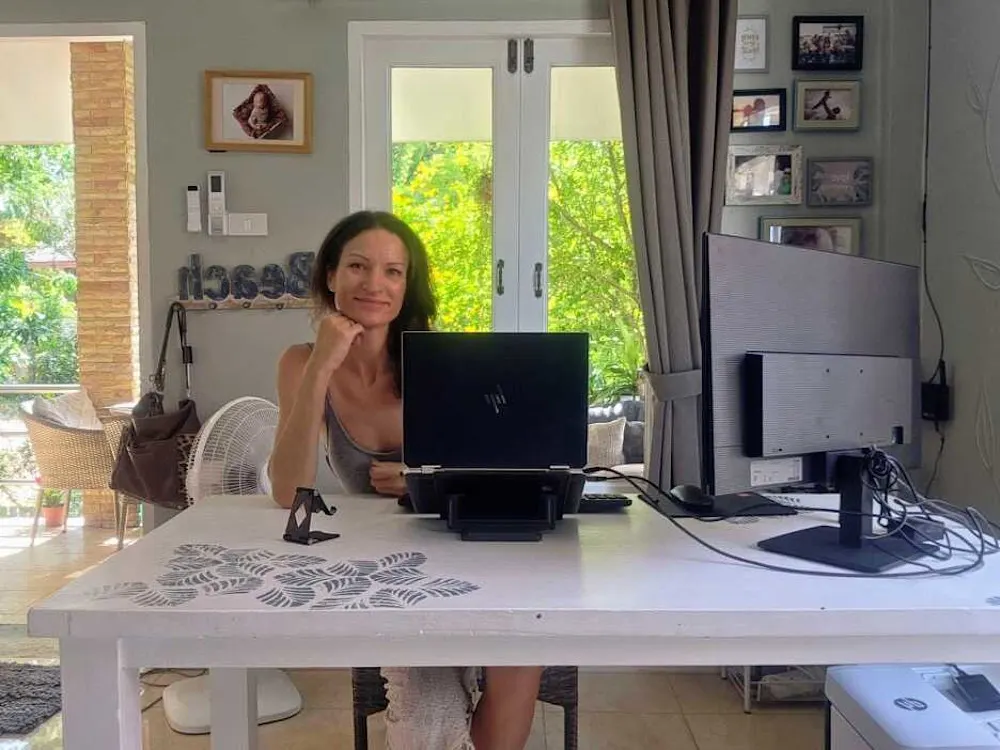
My office is a beach bungalow with big windows and a cross-breeze off the water. I have a second large screen, a wireless keyboard and mouse, and a laptop with enough battery to take on the road. I also have a tablet with a keyboard case and an up-to-date smartphone. I keep my tech as current as my wallet allows, because abroad, your devices stop being conveniences and start being infrastructure. Budget around $2,500–3,000 across laptop, tablet, and phone—spread over a few years, it’s not the barrier people imagine.
For backup, I have a handful of cafes with reliable Wi-Fi for power-cut days, and my phone doubles as a 5G hotspot when needed. My fiber optic Wi-Fi costs $17 a month. A cafe day, including coffee and breakfast, runs about $8.50. Cheap insurance.
The digital stack is where most people seriously underinvest. Notion is the backbone of everything, and Notion AI is, without exaggeration, a game-changer. I run both of my Substack publications entirely out of Notion, alongside my financials, editorial calendar, client projects, and a daily planning dashboard built around my schedule and energy levels. Worth every minute of the learning curve. I pay $30 a month on the monthly plan, or $20 annually.
Beyond Notion, my core stack includes TickTick for task management ($3/month), Google Calendar for time-blocking, Evernote as my mobile library ($11/month), Google Keep as my life database (free), and Google One for 2TB of cloud storage ($10/month). My Squarespace website handles my copywriting and editing presence at $16/month. For creative work, Canva Pro ($15/month) and CapCut ($10–20/month). For payments across borders, Wise and Stripe. For content scheduling—essential when your audience is awake while you sleep—I use Finn Tropy’s Substack Pro Studio and am exploring WriteStack, having previously used Later and Hootsuite.
Then there’s AI. Notion AI runs my content systems. ChatGPT handles heavier lifting. I’ve recently started using Claude for presentations and article carousels. Different tools, different strengths, collectively replacing hours of manual work.
The full monthly subscription costs $95–$105. Add Wi-Fi at $17, and you’re running a fully equipped remote office for around $120 a month.
But the digital stack is only part of the equation. Two costs that blindside almost everyone: visas and work trips.
Visa costs are rising—and not just in Thailand. Staying legal in your adopted country is non-negotiable. Don’t try to do it under the radar. It’s no life, and it’s not sustainable. Budget for it properly, treat it like a utility, and factor in the time it takes to manage—renewals, paperwork, and occasionally a trip to an embassy or border that eats an entire day. The peace of mind of being fully above board is worth every penny.
Work trips are the other one. Whether it’s flying home for a visa requirement, attending a conference, meeting a client in person, or handling banking in another country, these trips happen. Track them for a year, spot the rhythm, and then budget for them—both financially and in your schedule. They’re not optional extras. They’re part of the cost of running a location-independent life properly.
The point isn’t to replicate my exact setup. It’s to build one deliberately before you need it, rather than scrambling to patch holes after things go wrong.
The Mindset That Makes it Work
Get hyper-organized before you need to be. Back home, systems tend to keep you on track—payroll deducts your taxes, offices enforce lunch breaks, and HR reminds you to take holidays. Abroad, those guardrails disappear. You need to build your own: a steadfast organizational system, copies of every important document accessible from anywhere, and finances that account for taxes, visa costs, and the inevitable unexpected expense. Organization isn’t a personality trait abroad. It’s a form of self-protection.
Give yourself breaks—and not just throughout your day. It’s easy to skip lunch, work through weekends, and convince yourself that a change of scenery counts as a holiday. It doesn’t. Sick days, holidays, and proper rest need to be built into your schedule and your budget before you need them, not after. You cannot run a sustainable remote life on adrenaline alone.
Build a scheduling system that works while you sleep. For anyone maintaining a content or social presence, a good scheduler is non-negotiable when your audience is most active, while you’re at dinner or in bed. Automate what you can so your output isn’t held hostage by your time zone.
Find your people—deliberately. Abroad, isolation can creep up slowly. You have to be intentional about community—whether that’s a coworking space, a regular cafe where the owner knows your name, or an online community of people doing similar work. Connection doesn’t happen automatically when you step off the plane. You have to build it.
The Incomplete Sentence
The beach laptop photo isn’t a lie. It’s just an incomplete sentence.
The full version looks more like this: a bungalow office with a cross-breeze and a second screen, a phone doubling as a hotspot when the power goes out, a Notion dashboard holding the whole operation together, and a school run at 2:45 that marks the end of the official working day. It looks like late-night calls you’d rather not be taking, and mornings slow enough to start with meditation and coffee before the chaos begins. It looks like a life that is genuinely, messily, beautifully worth it—just not in the way the photo suggested.
Sixteen years in, I wouldn’t trade this life. But I’d build it differently from the start—treat organization as infrastructure, build backup systems before needing them, and schedule rest the same way I schedule client calls.
The remote work life abroad is real and available to more people than ever. But it rewards those who approach it like a puzzle to solve, not a fantasy to inhabit. Get the setup right, protect your time, find your people, and the dream becomes something better than the photo: an actual life, built exactly the way you want it.
Just maybe not on the beach.
Your chance to retire overseas now
Your chance to retire overseas now
Learn more about Thailand and other destinations by signing up to our daily IL Postcards e-letter and we'll immediately send you a free report: 20 Countries Compared, Contrasted, Ranked, and Rated.
You don’t have to be rich to enjoy a pampered retirement, you just need to know where to go.
With our 34th Annual Global Retirement Index, our experts hand you a detailed roadmap. Details and a Special Offer Here!
By submitting your email address, you will receive a free subscription to IL Postcards, The Untourist Daily and special offers from International Living and our affiliates. You can unsubscribe at any time, and we encourage you to read more about our Privacy Policy.