

It was late on a sunny afternoon several months back. I was sitting in the office of my historic villa in northern Portugal—looking out the window at Atlantic waves rolling onto golden-sand beaches—as I wrapped up an online catch-up with my scouting team.
“When will you get to Spain?” my scout Eoin Bassett asked.
“If I leave now… about 15 minutes,” I said. I wasn’t exaggerating.
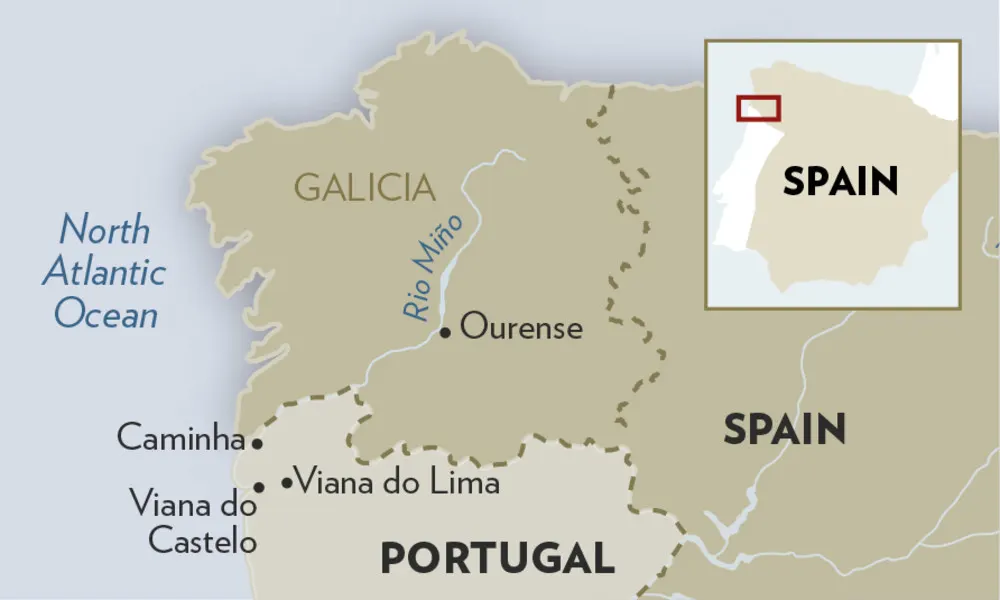
In 2024, I bought a historic mansion in Caminha, in Portugal’s far north. From my office, I look straight across the Minho River—the natural border between Portugal and Spain. At the river mouth, beaches run down both coastlines. I’m so close to Spain that my iPhone regularly flips me into the wrong time zone. (Portugal is an hour behind.)
I bought this villa about 18 months after first scouting this region in 2023, when the entire area—the town of Caminha, the nearby city of Viana do Castelo, and river towns like Ponte de Lima—was virtually unknown to the foreign tourists, expats, and second-home buyers pouring into Portugal. But the value, lifestyle, and natural beauty were all there, hiding in plain sight. I could see what would happen next. This region would be discovered. People would come. Prices would rise. And that’s precisely what’s happened.
Still, even I’m taken aback by the sheer speed of the transformation now underway in this region of Portugal.
And that led to a question that tugged at me every morning I spent at my Caminha home last fall. I’d sip my coffee and look across the river toward the hills and beaches of Galicia—the Spanish region just a stone’s throw away—and wonder: If northern Portugal is taking off… will the opportunity leap the river into Spain?
There was only one way to find out. I went to see.
Free Report: Best Places in the World to Buy Real Estate
Free Report: Best Places in the World to Buy Real Estate
Sign up for IL's postcards and get the latest research on the best places in the world to retire. Including boots-on-the-ground insights on real estate and rental trends. Simply enter your email address below and we'll send you a FREE report - The World's Best Places to Buy Real Estate.

By submitting your email address, you will receive a free subscription to IL Postcards, The Untourist Daily and special offers from International Living and our affiliates. You can unsubscribe at any time, and we encourage you to read more about our Privacy Policy.
The Transformation of Portugal’s “Undiscovered North”
Portugal has undergone a stunning transformation over the past decade. From Lisbon to the Algarve, from the Silver Coast to Porto, towns and cities across the country are now inundated by tourists for long stretches of the year. Real estate prices in the best-known destinations have soared. But head just 30 minutes north of Porto—outside the reaches of its extended metropolitan area—and everything changes.
Here in Portugal’s far north, you find all the elements that make the southern destinations so appealing: soft-sand Atlantic beaches, incredible food, rich history, and culture. But real estate prices can be astonishingly low compared to better-known coastal regions farther south.
Now that’s changing—fast.
Caminha and the surrounding towns are attracting new visitors and real estate buyers. Two years ago, there were five great, inexpensive homes for every buyer. Today, it’s one-to-one. And we’re now heading toward a point where five buyers will be competing for every good home.
My wife and I paid €410,000 ($481,610) for our 5,000-square-foot historic home in Caminha in late 2024. That worked out as just $90 per square foot in dollar terms. Given the trajectory this region is on, I expect it will be worth €1 million ($1,174,660) within five years.
Plus I expect rental income. Homes like this rent for €600 to €700 ($700 to $830) a night during peak season from mid-July through August. That means I can expect to cover the entire cost of owning this villa (mortgage, taxes, insurance, everything) just for filling it with renters during August, when demand is strongest.
With opportunities like this, it’s easy to see why buyers are coming to this region of Portugal.
And it’s easy to see why rising prices might push them to look across the river to neighboring Galicia.
Looking Across the Border
Galicia is an autonomous region of Spain. Located in the northwest of the Iberian Peninsula above Portugal, it’s a place of emerald countryside, granite towns, incredible food (especially seafood), and a historically strong local economy powered by fishing, shipbuilding, manufacturing, and agriculture.
Like the far north of Portugal, Galicia has a temperate Atlantic climate—cooler and greener than most of Spain. Winters are mild and wet, summers are warm, and year-round rainfall keeps the landscape lush. It’s one of Spain’s freshest, most temperate climates.
I began my scouting of Galicia in the waterfront region visible from my Caminha home, just 15 minutes away. Technically, there is a border between northern Portugal and Galicia. Though in reality, these worlds merge. There are no passport checks—Spain and Portugal are both in the European Union and Schengen Zone. Bridges span the river. People move seamlessly between the two sides every day. Many folks live on one side and shop or work on the other. And the Galician coast here is almost as close to Porto airport as Caminha is—around an hour and 15 minutes by car.
Architecturally and culturally, this border region of Galicia also shares much with Caminha.
There’s old money up in this northwestern corner of Iberia—wealth that came from the colonies. Places like Brazil. Generations ago, people pursued their version of the American Dream abroad, then returned home with fortunes big and small, and built elaborate homes.
These homes dot Galicia, as they do Caminha. In Caminha, many are being restored. But in Galicia, a large number still remain neglected or abandoned. They’re cheap—really cheap. This is reflective of the fact that real estate prices on the Galician side of the river are generally lower. They are roughly where Caminha prices were 18 months ago, before the taps opened and foreigners started buying.
By way of example… I wrote to my Real Estate Trend Alert group some months ago about a listing I found for a stunning historic mansion in Galicia. It has six bedrooms, two bathrooms, and 5,970 square feet. Inside are vaulted ceilings, traditional mosaic tiles, and charming historic features. From multiple rooms and terraces, you look directly across the Minho River to the rolling hills of Portugal. It’s virtually my view, but from the other side of the river.
The façade of the mansion is well maintained. The 11,000-square-foot plot offers a generous garden. A Guarda, a Spanish town, is at your doorstep. And with a bridge a short drive away, you can be in Portugal in 15 minutes and in downtown Caminha in under 30.
The asking price? €535,000—about $623,420. Yes, it needs modernization. But at that price, you’re owning at about $104 per square foot.
Will homes like this see the kinds of uplifts happening in Caminha? That will come down to what’s next for this corner of Galicia—whether people start coming in big numbers. I’m still digging… still researching. For now, another part of Galicia has also caught my attention, thanks to an insider tip.
Get Your Free Spain Report Today!
Get Your Free Spain Report Today!
Learn more about the lower cost of living in Spain and other countries in our free daily postcard e-letter. Simply enter your email address below and we'll also send you a FREE REPORT — Live the Good Life in Sunny, Affordable Spain.

By submitting your email address, you will receive a free subscription to IL Postcards, The Untourist Daily and special offers from International Living and our affiliates. You can unsubscribe at any time, and we encourage you to read more about our Privacy Policy.
A Tip From the Locals
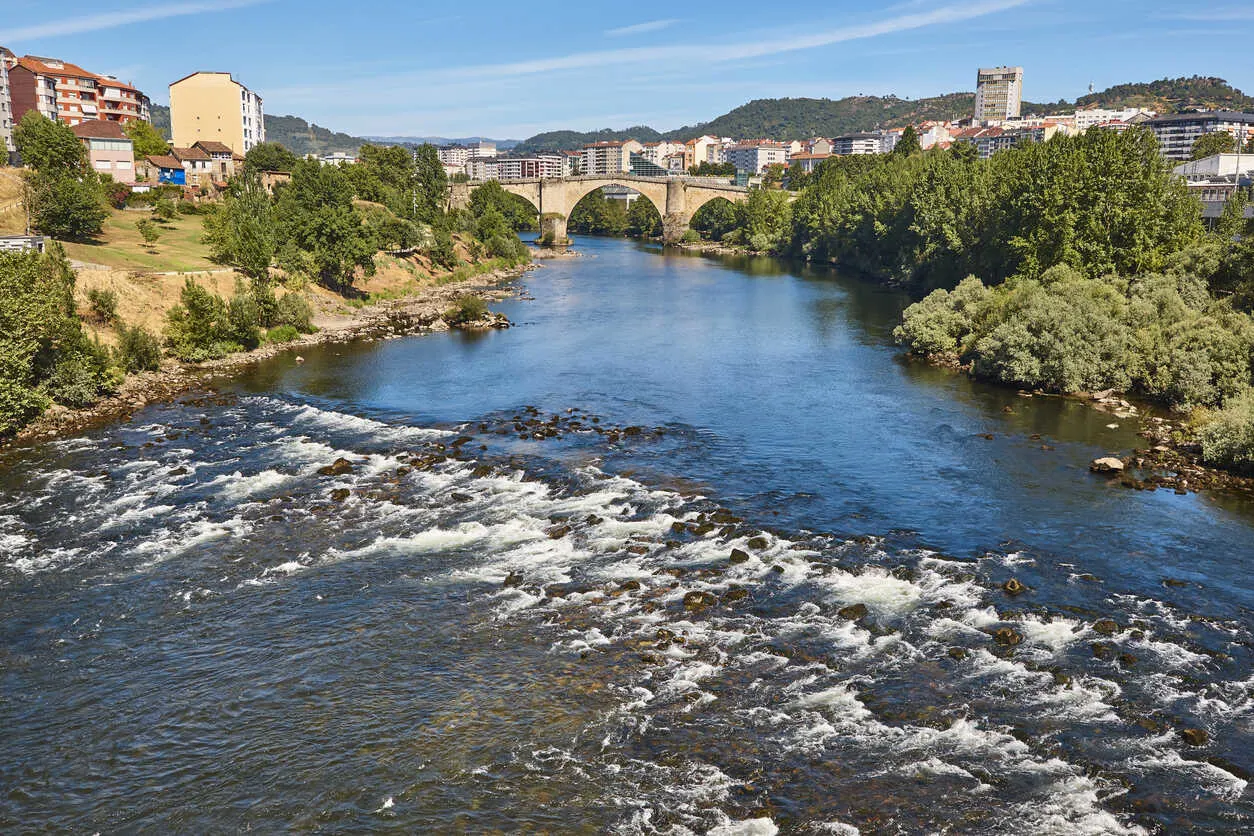
After buying our villa in Caminha, my wife and I did some renovation work. All the contractors who worked on the home were from the Roman-era city of Ourense in Galicia and they raved about its beauty and its extremely low real estate values.
They told me you can still buy stunningly renovated historic homes there for under €100 ($118) per square foot. And it’s so beautiful that renowned singer Julio Iglesias bought there. I couldn’t ignore a tip like that. So I made a point to investigate Ourense on my second scouting foray into Galicia.
Located inland, about 90 minutes’ drive northeast of Caminha, Ourense is known as “the city of gold”—a nod to its Roman-era prosperity. The historic center is a maze of narrow streets, Romanesque churches, and lively plazas filled with cafés and tapas bars. Its crown jewel is the Roman Bridge, a magnificent stone span that has crossed the river since the first century. And everywhere you turn, there’s water: the famous As Burgas hot springs in the city center, or the open-air thermal baths along the Minho where locals soak year-round.
Ourense has a thriving cultural scene, with theaters, wine bars, and easy access to the Ribeira Sacra wine region.
It’s lovely, but in general I found that Ourense—and Galicia more broadly—lacks some of the refinement and Old-World charm that makes Caminha so attractive. That’s a function of history. Galicia’s cities and towns industrialized in a way that northern Portugal around Caminha didn’t. As I say, the money in this northern part of Portugal came from people returning with colonial fortunes—mostly from Brazil. As a result, northern Portugal stayed simpler, but you often see ornate finishes that reflect those fortunes.
The landscapes of Galicia carry more of a post-industrial legacy. That said, the low cost of living and high quality of life in Ourense make it compelling. A day’s entry to the more luxurious thermal baths was €6.65 ($7.80). A large coffee and a bottle of water cost €3.00 ($3.50). A meal for two set me back just €13.20 ($15.50)—and it could have fed four.
Real estate is inexpensive as well. Sitting in Plaza Mayor—the main square of the historic center—I opened the Idealista real estate app available in Portugal and Spain and checked the three nearest listings:
A four-bath duplex in the Old Town for €540,000 ($634,318), built in 2003, with 2,637 square feet of usable space.
A ground-floor new-construction apartment for €210,000 ($246,678), with two bedrooms, two bathrooms, a terrace, and a cellar
A three-bed, one-bath detached house with a terrace and balcony for €60,000 ($70,480).
Three very different price points. About €185 ($217) per square foot gets you the top end.
Ourense is a lovely place to spend time. But is there an opportunity here? As with the border region near Caminha, the answer is: we’ll see. It lacks some of the refinement of northern Portugal, but there is definitely something special about this region.
I’ll be scouting here again when I return to Europe later this year. For now, Ourense—and Galicia more broadly—is firmly on my radar.
Free Report: Best Places in the World to Buy Real Estate
Free Report: Best Places in the World to Buy Real Estate
Sign up for IL's postcards and get the latest research on the best places in the world to retire. Including boots-on-the-ground insights on real estate and rental trends. Simply enter your email address below and we'll send you a FREE report - The World's Best Places to Buy Real Estate.
By submitting your email address, you will receive a free subscription to IL Postcards, The Untourist Daily and special offers from International Living and our affiliates. You can unsubscribe at any time, and we encourage you to read more about our Privacy Policy.