

If you’re looking for all the benefits of the south of France—sunshine, fine living, Mediterranean rhythms—without the bling-bling of the Riviera or the seasonal crowds of Provence, try heading to Occitanie, southern France’s laid-back, easygoing cousin. There’s a reason the region is less talked about than the French Riviera or Provence: it’s just less sensational, more authentic.
A salt-of-the-earth type of place, the mega yachts of Antibes, Saint-Tropez, or Cannes have been replaced with cowboy ranches, wetland reserves, and vineyards adjacent to the sandy beaches of the Camargue national park. Vin de sable, sand wine, grown in the actual sand-mixed earth of the Camargue, is a well-known product of the region. A light rosé that pairs well with the abundant seafood of the various beach communities that stretch along the coast toward Montpellier.
One of many joys and gourmet discoveries that have helped bring the region to light and call for a deeper look into why Occitanie could be an excellent choice for moving to France. You’ll also find real estate prices at around 20% less, in many areas, than their French Riviera equivalents.
Below are five towns in Occitanie that are quietly rising in popularity, and might just be perfect for you.
Get Your Free France Report Here
Get Your Free France Report Here
Learn more about France and other countries in our daily postcard e-letter. Simply enter your email address below and we’ll send you a FREE REPORT: A Taste of France: All the Ingredients for the Good Life.

By submitting your email address, you will receive a free subscription to IL Postcards, The Untourist Daily and special offers from International Living and our affiliates. You can unsubscribe at any time, and we encourage you to read more about our Privacy Policy.
La Grande Motte
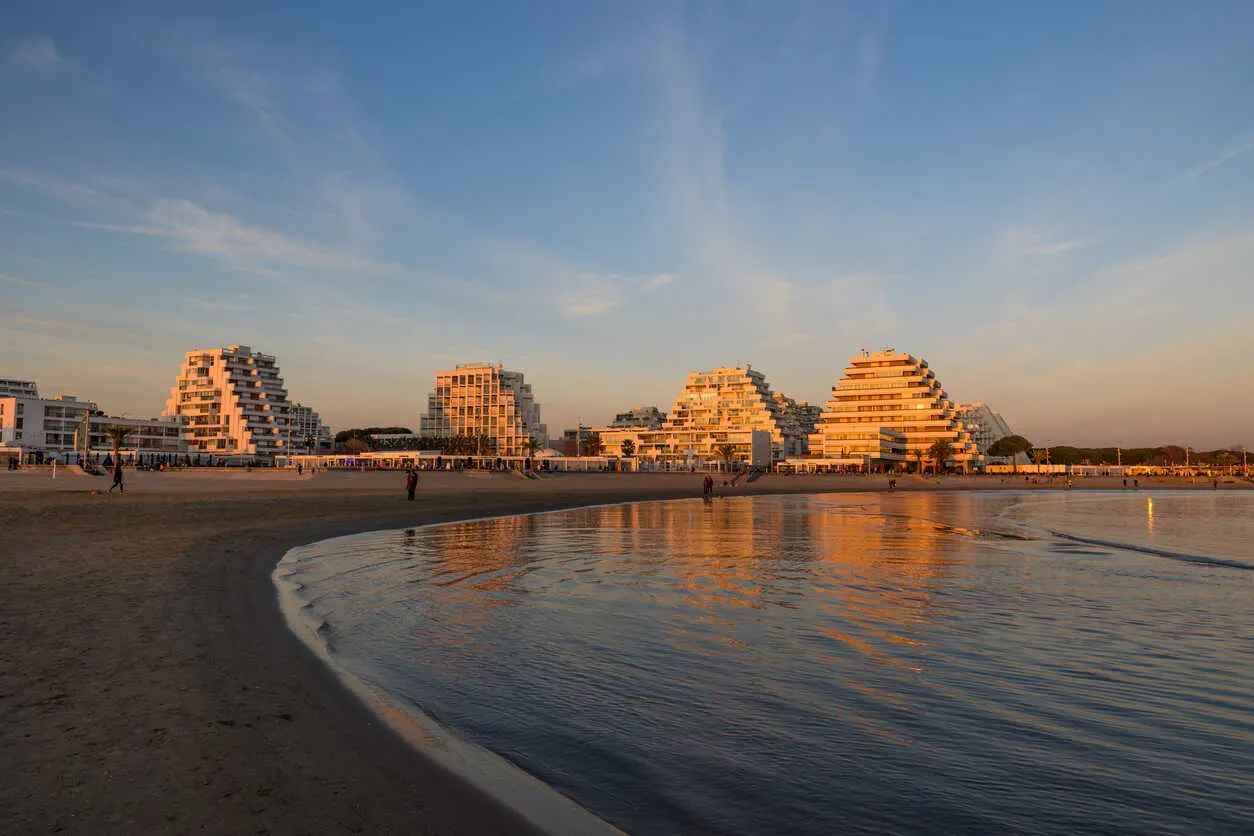
La Grande Motte: an up-and-coming retirement destination with an interesting and altogether unique backstory. Once a deserted corner of marshland on the shores of the Mediterranean, the city was built from the ground up in 1963, under the direction of General de Gaulle and visionary architect Jean Balladur.
The goal was to build a resort destination to attract French tourists and visitors from Northern Europe. It was to become the “Florida of the south,” and while you won’t find any alligators or iguanas competing for your lounge chair, the architects of La Grande Motte got the assignment right—a lush, beach/retirement community that’s come out of the shadows in recent years.
Due to its striking aesthetic, Balladur took inspiration for his buildings from pre-Colombian Mexican temples that resemble a series of pyramids along the skyline. La Grande Motte was once thought of as a quirky vacation stop along the way to more sophisticated (and pricier) towns like nearby Aigues-Mortes.
Now, its uniqueness has become its singular charm.
While visitors may first be struck by the eye-popping architecture, they stay for the quality of life.
La Grande Motte is surrounded by nature on all sides. While cafés, bistros, and beach clubs line the promenade and the sailboat-filled port, the rest of the town is taken up with parks, bike trails, and golf courses. Indeed, approximately 70% of the town has been dedicated to green spaces, whether natural or part of the urban landscape.
The living is easy, and the views stretching up and down the Mediterranean coast are quite spectacular. Since the town is a short drive from Montpellier, you’re never far from the distractions of a larger French city—world-class arts and entertainment, museums, and conferences—while enjoying the slow rhythms of the south. Montpellier has a regional airport for connecting flights in France and flights around Europe, excellent rail and bus service, and quality hospitals and clinics.
Montpellier
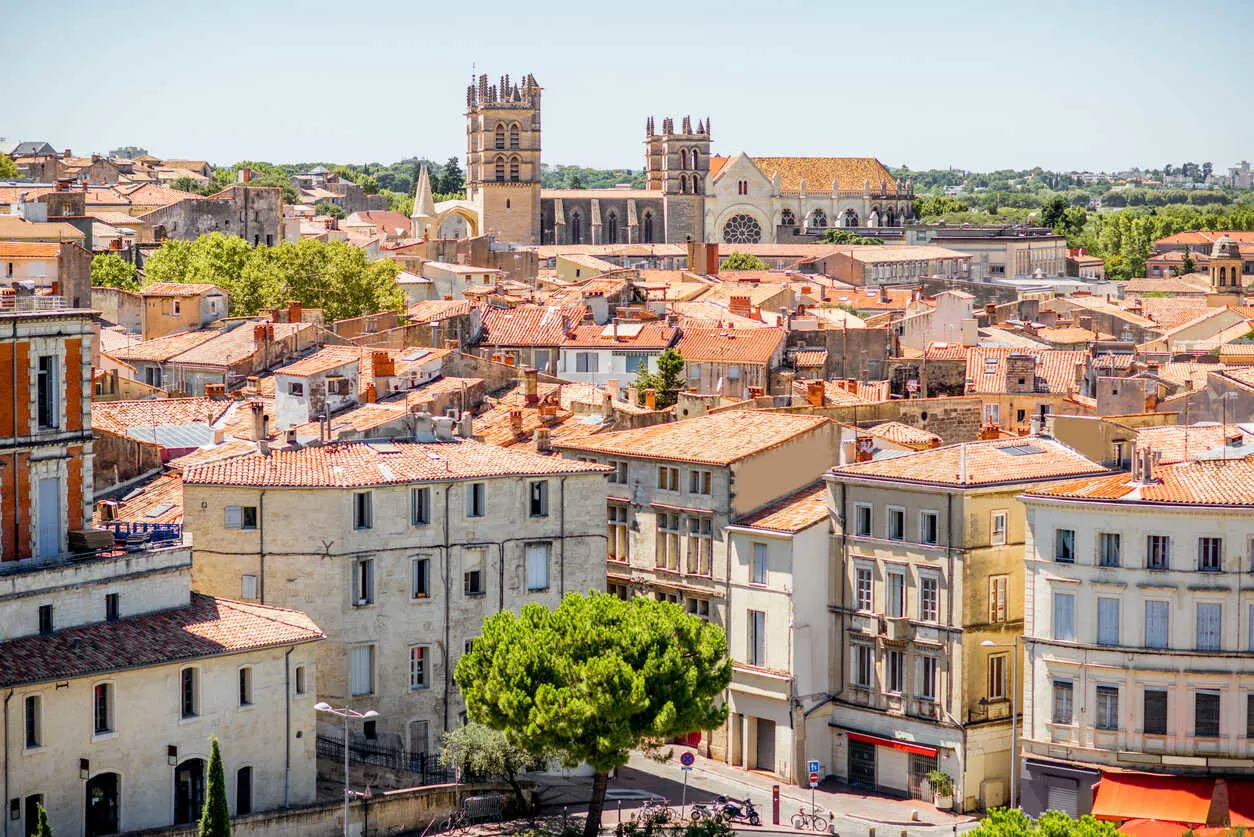
If you’d like the ease of living in a larger city while still getting that small-town, southern-France feel, Montpellier could be right for you.
As one of France’s fastest-growing cities, there’s no shortage of places to live. The city mixes classic Haussmannien-style dwellings with daring modern structures like L’Arbre Blanc, an apartment building where the layered balconies give the appearance of a giant tree keeping watch over the city.
This eclectic design is a good metaphor for Montpellier itself. Here, you’ll find something for everybody—from avant-garde art installations and French rock ‘n’ roll concerts to classical ballet and opera shows at the famous Opéra Orchestre National on Place de la Comédie square. The welcoming Place de la Comédie is the central hub of the city and a perfect spot to take advantage of the bon vivant (good living) attitude of the south.
Enjoy breakfast or lunch at one of the sidewalk bistros, tour the local farmers markets (a feast for the senses), or take a stroll through the plane-tree-lined garden of Champ de Mars. Stop by the flower market or pop in to the nearby Fabre Museum (decorative arts). The Corum concert and exhibition hall lies at the far end of the garden.
Fanning out from the Place de la Comédie, the rest of the city is a collection of easily reached (on foot or by bus) neighborhoods—with their own farmers markets, boutiques, bakeries, and cozy cafés. As Montpellier is one of the sunniest cities in all of France, you’ll find folks live most of the year outdoors, enjoying mornings on the terrace at their favorite café and perhaps a trip to the beach in the afternoon. The city is only eight miles from the Mediterranean, with easy bus and shuttle access.
Montpellier’s hospital network, the CHU, is made up of six different hospitals, two clinics, and one medical institute. The CHU website can be accessed in French or English.
Besides a lively food scene, Montpellier hosts several festivals every year, including the International Guitar Festival, Festival de Radio France et Montpellier (with opera, classical music, and jazz), and Cinémed, the International Mediterranean Film Festival.
Get Your Free France Report Here
Get Your Free France Report Here
Learn more about France and other countries in our daily postcard e-letter. Simply enter your email address below and we’ll send you a FREE REPORT: A Taste of France: All the Ingredients for the Good Life.
By submitting your email address, you will receive a free subscription to IL Postcards, The Untourist Daily and special offers from International Living and our affiliates. You can unsubscribe at any time, and we encourage you to read more about our Privacy Policy.
Narbonne
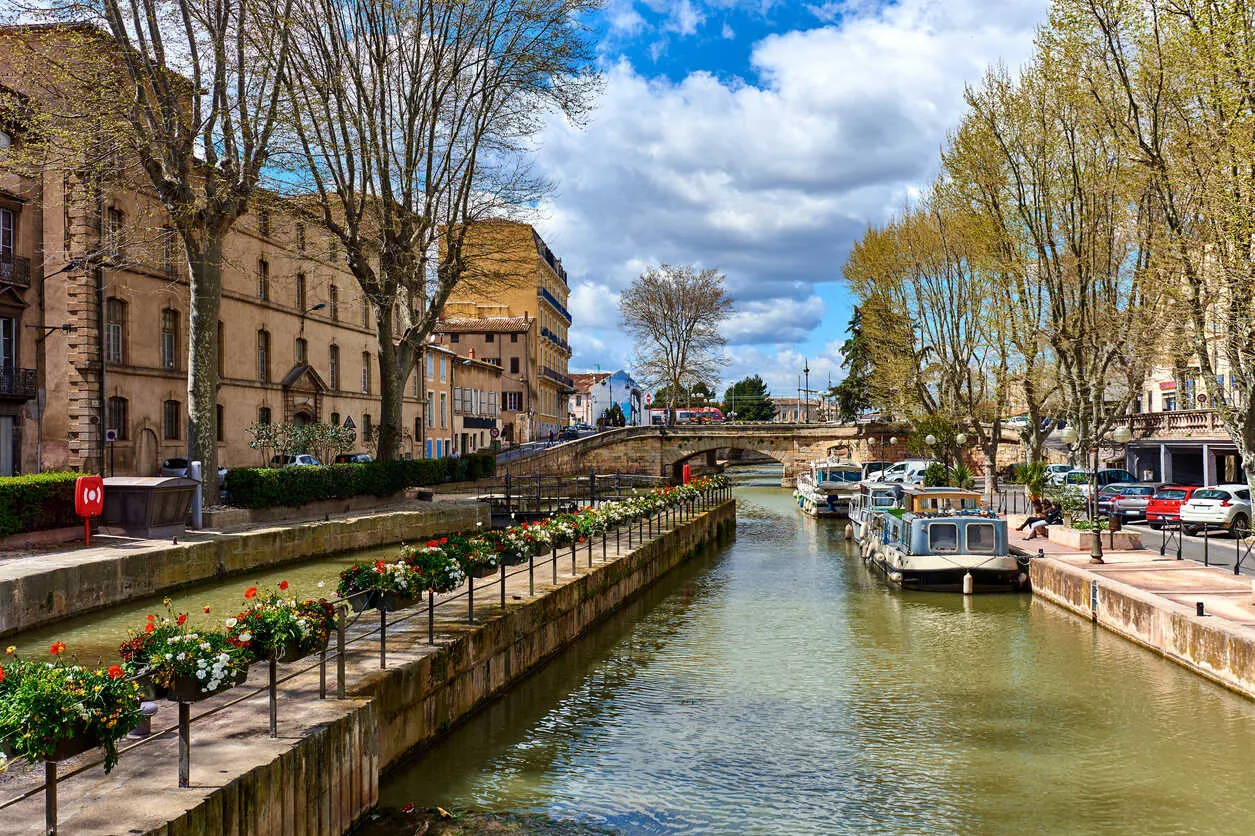
About an hour south of Montpellier, Narbonne is another Occitanie destination that warrants a closer look.
The town of about 57,000 residents is close to the sea (around 25 minutes) and next to Narbonne National Park—a protected natural space that includes beaches, lagoons, vineyards, and hiking trails. A seasonal resort area, called Plage Narbonne (Narbonne Beach), is popular with visitors and locals.
The city was a central figure during the growth of the local wine industry and saw a surge in development at the start of the 20th century with the construction of elegant, Haussmannien-style boulevards and the introduction of stately cafés.
It remains a foodie destination par excellence—principally known for the world-famous Grands Buffets, a 21,500-square-foot dining hall dedicated to preserving 19th-century French cuisine, which boasts 150 entrées, main courses, and desserts. The cheese section, consisting of 124 different cheeses, is listed in the Guinness Book of World Records as the biggest “cheese plate” in the world.
Narbonne’s historic center has a collection of gourmet bistros and restaurants, with the covered food hall an easy way to grab a quick lunch or picnic on the go.
The town has a lot of southern charm, with the historic center intersected by a canal (Roubine) and crisscrossed by impressive stone bridges, giving a bit of Venice flair. Home to several medieval and Gothic monuments, part of the Via Domitia—which linked Italy to Spain in the 2nd century BC—was discovered in the center of town in 1997.
The driving time to Spain is about an hour and 20 minutes, which also makes Narbonne attractive for folks looking to head south of the border.
Nîmes

Further inland from Montpellier (about a 45-minute drive) but still in the Occitanie region, you’ll find the captivating city of Nîmes. Known as the “Rome of France,” Nîmes has the highest concentration of Roman ruins in the country, with La Maison Carrée (a preserved Roman temple) inscribed as a UNESCO World Heritage Site.
Indeed, from the striking Roman arena—the emblem of the city—to the Temple of Diane and the Magne Tour, a walk through the historic center is a passage back in time.
Beyond the architectural beauty of the city, Nîmes is just very easy to get around… and very accessible. Starting from the Roman arena (nearby Esplanade Square is host to many annual festivals), residents can enjoy an easy walk through the pedestrian center, stopping at any of the boutiques, bookstores, bakeries, chocolate shops, or cafés along the way.
Sunlit, blonde-stone and whitewashed buildings open up to palm tree-lined squares. Enjoy a plate of tapas and a local light rosé (the Costières-de-Nîmes appellation) and some fantastic people-watching.
Nîmes is a very laid-back, come-as-you-are destination, as witnessed by the town’s signature annual event—La Feria de Nîmes. Two separate events, one taking place in the spring and celebrating the town’s Spanish heritage, and the second held each September to honor the local grape harvest, see the town turned into one large fiesta.
If you’re drawn to slow, southern living with a tinge of Latin flair, Nîmes could be your perfect spot.
Uzès
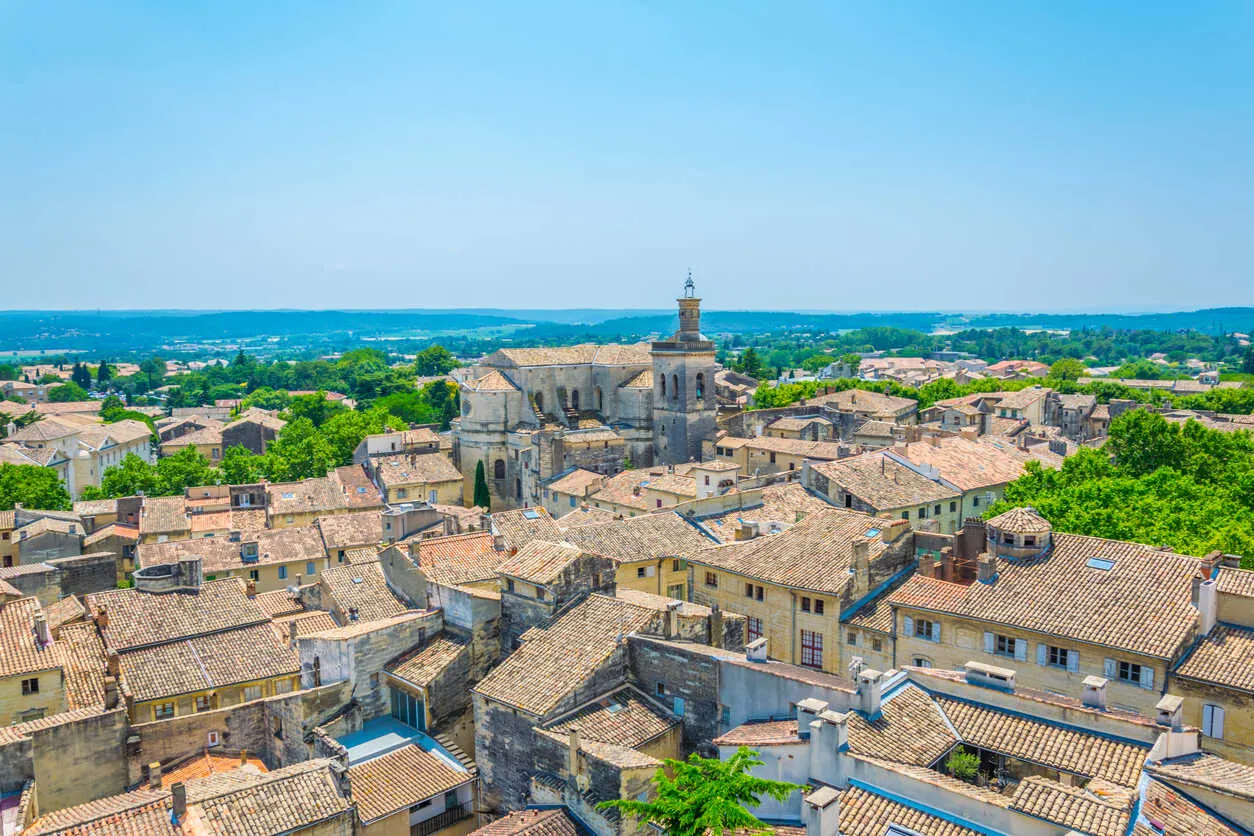
Leaving the seaside and Mediterranean vibes behind, Uzès is one of those magical French towns you visit on a scouting trip and never want to leave. Around an hour from Montpellier and 35 minutes north of Nîmes, Uzès is like a modern-day fairytale—southern France style.
From almost every vantage point in this small hamlet (population 31,000), residents can see the stunning Ducal Palace—a medieval château with a chapel, elegant French gardens, an imposing fortified tower (climb the steps for an unparalleled view of the historic center below), and sumptuous apartments furnished with tapestries, portraits, and family heirlooms.
One of the oldest duchies in France, the Duchy of Uzès was the first duchy of the kingdom. The palace is still privately owned by the Crussol d’Uzès family, who have held the estate (with a few changeovers) for over a thousand years.
The Ducal Palace is just one of many breathtaking medieval buildings in town, including the Place aux Herbes (medieval market square) and the Fenestrelle Tower, or the “leaning tower of Uzès.” Attached to the Romanesque cathedral of Saint-Théodorit, the campanile-style tower bears a striking resemblance to its famous Italian namesake.
All in all, Uzès just might be the most beautiful town in Occitanie. Think golden-stone, high-walled streets with hanging ivy and peekaboo bougainvillea swirling up the side of medieval “townhomes”—all under the gaze of sky-high towers and fortified ramparts. Throw in some top-tier dining (even a Michelin-starred restaurant, La Table d’Uzès) and Paris-level chic boutiques and, well, you feel quite royal.
In recent years, more and more Americans have chosen Uzès for their retirement, giving this somewhat “hidden gem” its moment in the sun.
The World’s Best Retirement Havens for 2026
The World’s Best Retirement Havens for 2026
24 Countries Compared, Contrasted, Ranked, and Rated. You don’t have to be rich to enjoy a pampered retirement, you just need to know where to go. With our 35th Annual Global Retirement Index, our experts hand you a detailed roadmap. Details—and a Special Offer—Here

By submitting your email address, you will receive a free subscription to IL Postcards, The Untourist Daily and special offers from International Living and our affiliates. You can unsubscribe at any time, and we encourage you to read more about our Privacy Policy.